Introduction to Nepal Portal
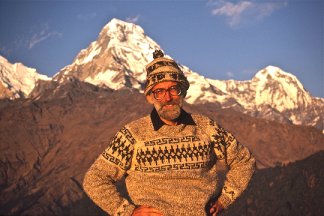
This unit on Nepal is based on material collected during
two expeditions -- in 1986 and 1996 -- and on communications maintained
for 25 years with a friend I met on my first trip.
In 1986 I joined a group of trekkers and, in the course
of a month’s walking, followed the valley of the Marsyangdi from Dumre
on the road east of Pokhara to the river’s source at Phedi; then over the
Thorung La pass to Muktinath and the gorge of the Kaligandaki River which
we followed as far as Tatopani. Here we left the gorge and, following tributaries
of the Kaligandaki, cut across country via Ghorepani and Lumle to
the lake at Pokhara.
Most of the photos in included in “Part Two : Life
in the High Country”, were taken during this period. So too were my
earliest photos of land use in the Midlands and in the Kathmandu Valley,
where I spent some time before I left the country. I had chosen to trek
in November and December, when the summer monsoon was long past, visibility
had improved, and rice and other summer crops were being harvested. Ours
was the last group to cross the Thorung La that year: it was snowing heavily
and the pass was closed by snow throughout the winter.
In the course of that trek I encountered a young
man walking beside the Kaligandaki with a gigantic copy of “Fowler’s English
Usage” under his arm. As is my wont I struck up a conversation with him,
learning that he was then teaching English at a local high school
-- and we have been friends ever since. When I returned to Nepal I lived
with him and his family -- first in the Midlands, then on the Plains.
My friend’s name is Gopal Sharma; and my coverage of “Life
in the Midlands” and “Life on the Plains” would not have been
possible without his help and direction. He opened many doors and made
it possible for me to film conditions and events which I could never have
done on my own -- including the exercise of religious faith in a Hindu
society. I was there in the spring, at the time of the Little Dasain festival;
and was able to attend religious ceremonies where I was the only
person who was not a member of the local community. I was able thereby
to obtain photographs of events which are seen by few “outsiders” -- with
Gopal serving sometimes as my cameraman. The sound recordings
and video clips all date from this second trip, that is from 1996.
The 33 video clips provide a varied (and in several cases,
I believe, unique) window upon life in Nepal at a time when its era as
a Hindu kingdom was drawing to a close. But there were (and
are) inevitable limitations. My coverage of family life is detailed but
makes no claim to be comprehensive. My friend is a Brahman, and the behaviours
I observed are, therefore, representative of just one of the many cultural
groups, and sub-groups, which make up the population of Nepal. In other
words, in this study I have, inevitably, done no more than scratch the
surface of reality in a country which must surely rate as one of the world’s
richest countries culturally ... as well as the most beautiful!
View 778 high resolution photos, each with descriptive
text.
Plus
33 Videos and 103 Sound Effects
www.johntyman.com/nepal